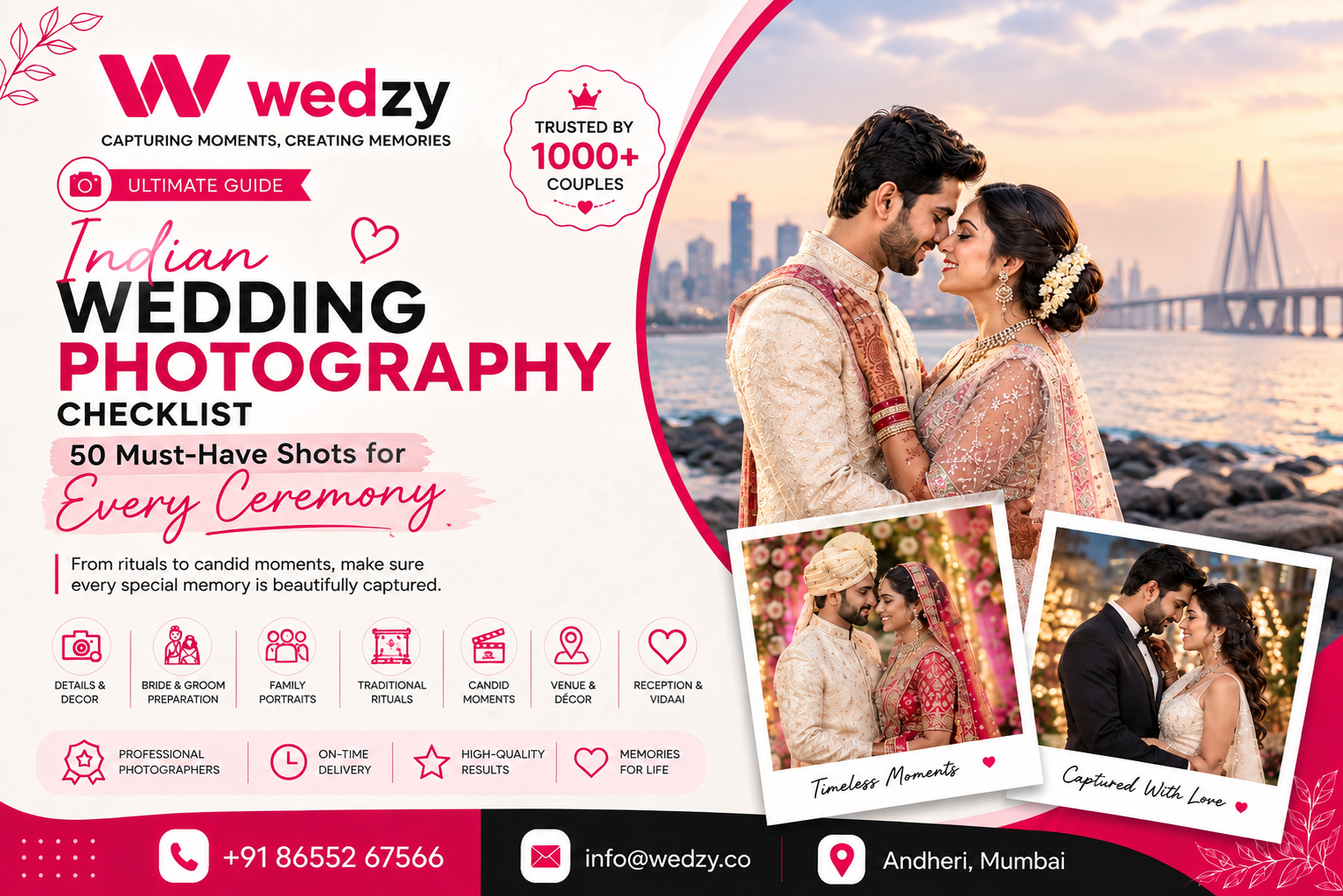
Indian weddings are full of moments that happen once and disappear in seconds. A bride’s reaction when she sees herself fully dressed, the groom meeting his family before the baraat, parents getting emotional during the vidaai, or cousins laughing in the middle of a ceremony—these are the photographs people remember years later.
The tricky part is that an Indian wedding is rarely just one event. There may be a haldi, mehendi, sangeet, baraat, varmala, pheras, reception and vidaai, often happening across different locations and timelines.
That is why having a proper Indian wedding photography checklist can make a huge difference. Instead of relying only on spontaneous clicks, the photographer and family know which important moments need attention.
This guide covers 50 must-have wedding photography shots, from preparation and rituals to family portraits and emotional candid moments.

Plan Your Wedding With Verified Professionals
Verified
Professionals
Trusted
Company
Easy EMI &
Secure Booking

Let's get started with a few details ✨
We never share your details.
Why You Need an Indian Wedding Photography Checklist
A good photographer doesn’t simply take hundreds of random pictures. The goal is to tell the complete story of the wedding.
Without a plan, small but important details can easily get missed. Maybe the photographer captures the varmala beautifully but forgets the bride’s grandparents. Or the decorations are photographed, but nobody remembers to capture the invitation card, jewellery or wedding rings.
A checklist works as a safety net.
It doesn’t mean every photograph has to look staged. In fact, the best approach is usually a combination of planned portraits, documentary-style photographs and natural candids.
A useful checklist should cover:
- Wedding details
- Bride and groom preparation
- Parents and close family
- Traditional rituals
- Couple portraits
- Group photographs
- Emotional moments
- Candid interactions
- Venue and décor
- Reception and vidaai
Internal linking opportunity: Link this section to a related guide such as How to Choose the Right Wedding Photographer.
50 Must-Have Shots for an Indian Wedding
1. Wedding Details and Décor
Before guests arrive, the photographer should take a few clean photographs of the setting.
- Wedding invitation card
- Wedding rings
- Bridal jewellery
- Bride’s outfit and footwear
- Groom’s sherwani, safa or accessories
- Mehendi close-up
- Floral decorations
- Mandap or ceremony setup
- Stage and reception décor
- Overall venue photograph
These images are especially useful in a wedding album because they establish the atmosphere before the celebrations begin.
A practical tip: ask the photographer to arrive early enough to photograph the venue while it is still neat and relatively empty.
2. Bride and Groom Getting Ready
Getting-ready photographs often become some of the most personal images in the album.
- Bride having her makeup done
- Bride getting her hair styled
- Mother or sister helping with jewellery
- Bride putting on earrings or bangles
- Final bridal look
- Groom getting ready
- Groom adjusting his sherwani
- Groom wearing his sehra or turban
- Groom with parents before leaving
- Bride’s final portrait before the ceremony
Don’t focus only on posed portraits. Small interactions between the bride and her family can make these photographs feel much more authentic.
For example, a mother fixing her daughter’s dupatta or a brother joking with the groom can tell more of the wedding story than another perfectly posed portrait.
3. Mehendi, Haldi and Pre-Wedding Celebrations
Pre-wedding functions are usually relaxed, colourful and full of candid moments.
- Bride’s mehendi application
- Close-up of completed mehendi
- Friends and cousins enjoying mehendi
- Haldi ceremony preparation
- Family applying haldi to the couple
- Natural laughter during haldi
- Couple portraits during pre-wedding functions
- Family dancing
- Friends performing at the sangeet
- Behind-the-scenes moments
These events are where photographers can experiment more with candid photography.
Instead of asking everyone to look at the camera, let people interact naturally. The resulting images often feel more alive.
Internal linking opportunity: A guide about Pre-Wedding Photography Ideas can naturally be linked here.
4. Baraat and Wedding Ceremony Shots
The main wedding day moves quickly, so communication between the photographer, couple and family becomes important.
Baraat Photography
- Groom leaving for the venue
- Groom riding in the car or on the traditional baraat setup
- Dancing family members
- Friends celebrating during the baraat
- Groom’s arrival at the venue
- Bride’s family welcoming the groom
The photographer should also watch for reactions rather than photographing only the main action. A father’s expression, children dancing nearby or friends celebrating together can add context to the story.
Varmala
- Bride’s entry for the varmala
- Groom’s reaction to the bride
- Bride and groom exchanging garlands
- Family and friends cheering
- Wide photograph showing the complete setup
The varmala can become chaotic because everyone wants to see the couple. A photographer should ideally position themselves where they can capture both close-up expressions and wider reactions.
Pheras and Traditional Rituals
- Couple sitting at the mandap
- Priest conducting the ceremony
- Sacred fire and ritual details
- Bride and groom taking the pheras
- Sindoor ceremony
- Mangalsutra ceremony
- Parents participating in rituals
- Couple’s expressions during important vows
- Final family and couple moments after the ceremony
Different Indian communities follow different wedding traditions, so the photographer should confirm the ceremony sequence before the event.
This is particularly important when there are rituals that cannot easily be repeated for a photograph.
Don’t Forget the Candid Wedding Photography Shot List
A checklist should not turn the wedding into a photo shoot.
Some of the strongest wedding photographs happen when nobody is posing.
Think about:
- Grandparents talking to each other
- Friends laughing together
- A child dancing at the sangeet
- The bride’s parents watching the ceremony
- Cousins teasing the groom
- A quiet moment between the couple
- Guests meeting after years
- Someone getting emotional during the vidaai
These photographs may not be part of a formal shot list, but an experienced photographer should always keep an eye out for them.
The best wedding photography shot list is flexible. It gives the photographer a structure without preventing them from documenting unexpected moments.
How to Organise Your Wedding Photography Checklist
A long list becomes useful only when it is easy to follow.
One simple method is to divide the checklist according to the wedding timeline.
Before the Wedding
Prepare a list of:
- Important family members
- Wedding details
- Bride and groom preparation
- Special cultural traditions
- Couple portraits
- Venue details
During the Ceremony
Mark the rituals that absolutely cannot be missed.
For example, if there are particular family traditions, tell the photographer beforehand rather than expecting them to understand everything automatically.
After the Ceremony
Keep time for:
- Couple portraits
- Immediate family portraits
- Extended family
- Friends
- Reception details
- Vidaai photographs
It is also helpful to nominate one family member who knows everyone. The photographer can ask that person to help organise group photographs.
This saves time and avoids the common situation where everyone is searching for a missing relative while the couple is waiting.
Common Mistakes Couples Make With Wedding Photography
Even a detailed checklist cannot solve everything if the planning is rushed.
Trying to Photograph Everything
You don’t need 20 versions of every ritual. Prioritise photographs that tell the story.
Ignoring Family Combinations
Couples often remember couple portraits but forget important family combinations.
Make a short family-photo list before the wedding.
For example:
- Couple + parents
- Couple + siblings
- Couple + grandparents
- Couple + immediate family
- Bride + parents
- Groom + parents
- Couple + close friends
Not Sharing the Timeline
A photographer needs to know when the bride is getting ready, when the baraat leaves and when major rituals begin.
Even a basic timeline can prevent missed opportunities.
Overplanning Every Candid
Candid photography works best when people are allowed to behave naturally. Give the photographer the important moments to watch for, but don’t try to manufacture every emotional scene.
Forgetting to Communicate Cultural Traditions
Indian weddings vary enormously from one family and community to another. Explain any important rituals, customs or restrictions beforehand.
Internal linking opportunity: Add a link here to Wedding Photography Planning Tips for Couples or a relevant wedding photography service page.
How Many Photos Should a Wedding Photographer Take?
There is no universal number that guarantees good wedding photography.
A photographer may capture hundreds or even thousands of images during a multi-day celebration, but the final value comes from the quality and variety of the selected photographs.
A strong wedding collection should have a balance of:
- Candid photographs
- Traditional ceremony photographs
- Couple portraits
- Family portraits
- Décor and detail shots
- Emotional moments
- Group photographs
- Creative compositions
The objective is not simply to collect a large number of files. It is to preserve the important parts of the wedding in a way that still feels meaningful years later.
FAQ: Indian Wedding Photography Checklist
1. What should be included in an Indian wedding photography checklist?
An Indian wedding photography checklist should include preparation photos, family portraits, décor, rituals, couple portraits, candid moments, baraat, varmala, pheras, reception and vidaai.
2. What is a wedding photography shot list?
A wedding photography shot list is a planned collection of important photographs that a couple wants their photographer to capture. It helps prevent important people, rituals or details from being missed.
3. Should wedding photography be mostly candid or posed?
A combination usually works well. Posed photographs are useful for family portraits and formal couple images, while candid photography captures natural emotions and interactions.
4. How do I make sure my photographer doesn’t miss important wedding rituals?
Share the wedding timeline and important rituals with the photographer before the event. Also identify any traditions that may be unfamiliar or happen only once.
5. Should I give my photographer a complete shot list?
Yes, but keep it practical. Give the photographer your must-have photographs and important family combinations while allowing enough freedom to capture unexpected candid moments.
Plan Your Wedding With Verified Professionals
Verified
Professionals
Trusted
Company
Easy EMI &
Secure Booking
Let's get started with a few details ✨
We never share your details.
Conclusion
An Indian wedding is made up of hundreds of little stories. The grand rituals matter, but so do the quiet moments between them—the nervous smile before the ceremony, a parent’s proud expression, friends dancing without caring who is watching, and the final goodbye at the end of the celebration.
A thoughtful Indian wedding photography checklist makes sure those moments don’t get lost.
Use the 50-shot list above as a starting point, then customise it around your family, traditions and wedding schedule. Share the final list with your photographer well before the wedding day so everyone knows which moments matter most.
If you’re planning your wedding photography, the next useful step is to review your photographer’s portfolio, discuss the ceremony timeline and create a personalised wedding photography shot list for your own celebration.