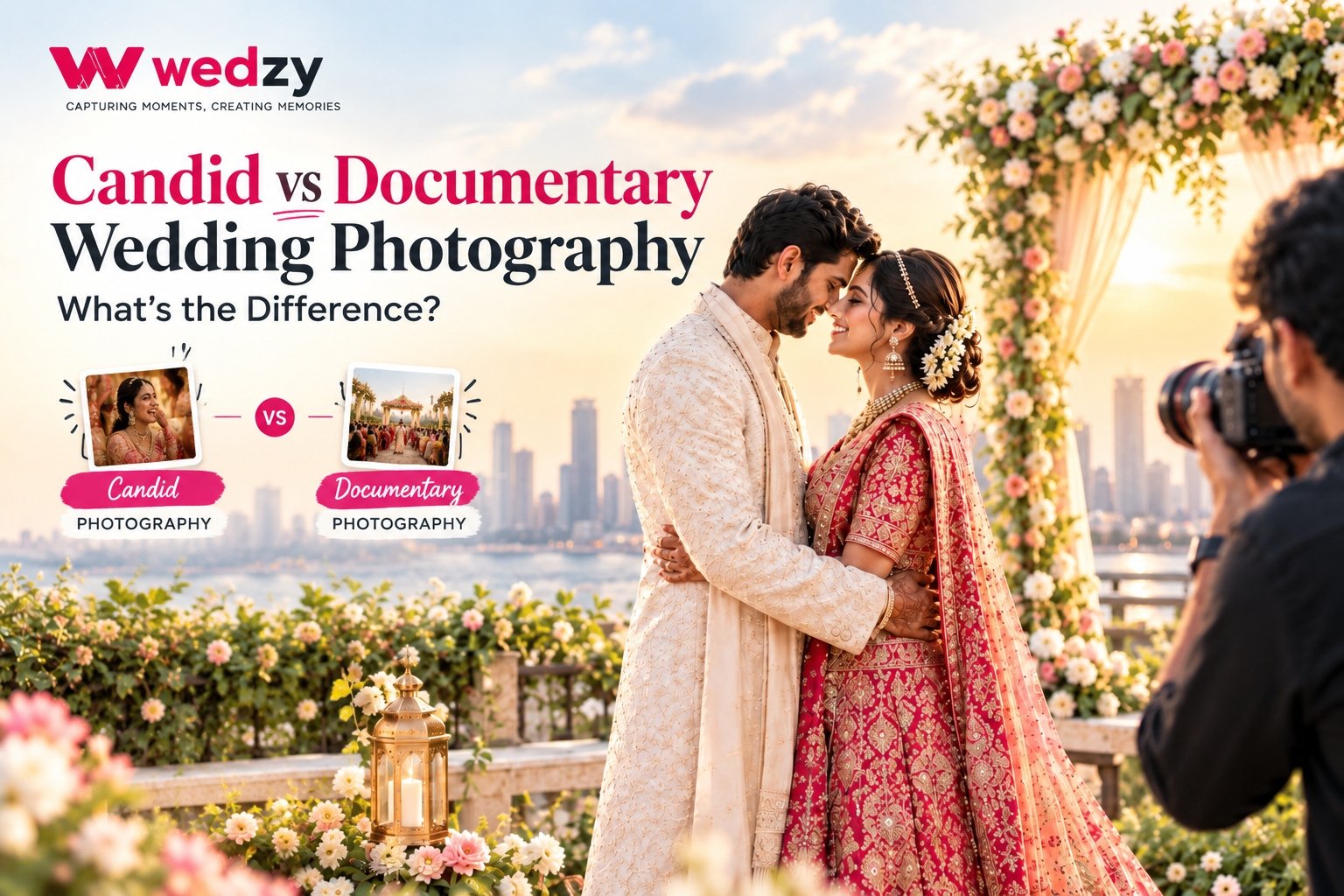
When choosing a wedding photographer, you may come across terms like candid wedding photography and documentary wedding photography. At first, they can sound almost identical. Both styles focus on genuine moments, natural expressions, and photographs that do not feel overly staged.
So, what actually separates them?
The difference is mainly in how the photographer approaches the wedding story. Candid photography focuses heavily on capturing spontaneous expressions and reactions, while documentary wedding photography takes a broader storytelling approach, recording the flow, atmosphere, people, details, and little moments that make the day personal.
If you are trying to decide between the two, this guide explains the differences, similarities, advantages, and situations where each style may work better for your wedding.

Plan Your Wedding With Verified Professionals
Verified
Professionals
Trusted
Company
Easy EMI &
Secure Booking
Let's get started with a few details ✨
We never share your details.
What Is Candid Wedding Photography?
Candid wedding photography is about capturing moments as they happen without asking people to pose for every photograph.
Think about a bride laughing with her friends before the ceremony, a parent becoming emotional during the vows, or guests reacting to an unexpected dance-floor moment. These are the kinds of photographs candid photographers look for.
The goal is generally to make the photograph feel natural rather than arranged.
What does a candid photographer look for?
A candid photographer may pay attention to:
- Natural facial expressions
- Emotional reactions
- Laughter and conversations
- Unplanned interactions
- Couple moments between formal events
- Reactions from family and friends
- Small gestures and spontaneous memories
For example, instead of stopping a couple during their wedding reception and asking them to recreate a laugh, the photographer may quietly capture the genuine moment while they are talking.
That is one reason candid photographs often feel personal when you look at them years later.
What Is Documentary Wedding Photography?
Documentary wedding photography goes one step further by treating the wedding as a complete visual story.
Rather than concentrating mainly on individual candid photographs, the photographer observes what is happening throughout the day and documents the environment, people, emotions, details, and sequence of events.
A documentary approach might include photographs of the venue before guests arrive, a grandmother watching the ceremony, children playing in a corner, the nervous moments before the baraat, decorations, family interactions, and the final celebrations.
The photographer is essentially trying to answer:
“What did this wedding actually feel like?”
Documentary photography is about context
Context is an important part of documentary wedding photography.
For example, a photograph of a groom looking emotional is meaningful. But a wider photograph showing his family standing nearby, the decorated ceremony space, and guests watching can tell a larger part of the story.
This does not mean documentary photography avoids close-up portraits. Instead, portraits and candid moments are combined with wider photographs and smaller details to create a complete visual narrative.
Candid vs Documentary Wedding Photography: Key Differences
Although the two styles overlap considerably, their approach is different.
| Candid Wedding Photography | Documentary Wedding Photography |
| Focuses strongly on spontaneous moments | Focuses on the complete wedding story |
| Often highlights expressions and emotions | Includes people, surroundings, details, and events |
| Can be used alongside traditional photography | Usually follows a storytelling approach |
| Photographer looks for natural reactions | Photographer observes the sequence of the day |
| Individual moments are often the priority | Overall atmosphere and narrative are important |
The distinction is not always strict. Many experienced wedding photographers combine candid and documentary techniques during the same wedding.
A simple example
Imagine the bride’s father seeing her for the first time.
A candid approach may capture his facial expression and emotional reaction.
A documentary approach may capture several photographs: the bride approaching, her father’s reaction, relatives watching, the surrounding setting, and what happens immediately afterward.
Both approaches can produce beautiful photographs. They simply tell the story from slightly different perspectives.
Which Style Is Better for a Wedding?
There is no universal answer because the right choice depends on what you want your wedding album to communicate.
If you mainly want natural expressions, emotional portraits, and spontaneous interactions, candid photography may be an important part of your photography coverage.
If you want photographs that show the entire atmosphere and progression of your wedding day, documentary photography may be particularly appealing.
For many couples, the practical answer is not choosing one exclusively.
Why combining both styles can work
A wedding day contains different types of moments.
You may want:
- Family group photographs
- Couple portraits
- Candid reactions
- Ceremony details
- Emotional moments
- Guest interactions
- Venue photographs
- Dance-floor celebrations
- Small details that might otherwise be forgotten
A photographer who understands both candid and documentary techniques can move between these situations without making the wedding feel like a continuous photoshoot.
Internal linking opportunity: This is a natural place to link to a related guide about candid vs traditional wedding photography.
Documentary Wedding Photography for Indian Weddings
Documentary photography can be particularly interesting for Indian weddings because there is usually a lot happening at the same time.
A wedding may include multiple ceremonies, relatives arriving from different places, preparation rituals, food, music, dancing, religious customs, and interactions between different generations.
Some of the most memorable photographs may not be the obvious ones.
A photographer might capture a mother adjusting the bride’s jewellery, cousins joking during preparations, grandparents watching the ceremony, children running around the venue, or relatives meeting after years apart.
These moments can easily disappear if photography focuses only on formal portraits.
Don’t overlook the small moments
Couples often remember the major events clearly. Years later, however, smaller details can become surprisingly valuable.
The wedding invitation on a table.
A close friend fixing the groom’s outfit.
Parents waiting before the ceremony.
A relative laughing during a family conversation.
These photographs may not have been planned, but they help recreate the atmosphere of the day.
That is one of the strongest reasons people choose documentary-style coverage.
How to Choose the Right Wedding Photography Style
Before booking a photographer, think about how you want to remember your wedding.
Ask yourself a few simple questions.
Do you enjoy posed photographs?
If you want a significant number of carefully composed portraits, make sure the photographer is comfortable with guided posing as well as candid coverage.
Do you prefer natural expressions?
If staged photographs are not really your thing, ask to see complete wedding galleries rather than only selected portfolio images.
Do you want the story of the entire day?
If the answer is yes, ask whether the photographer provides documentary-style coverage and how they approach moments outside the main ceremonies.
Can you see a full wedding gallery?
This is one of the most useful questions you can ask.
A photographer’s website may show 20 excellent photographs from different weddings. That does not necessarily tell you how they cover an entire event.
A complete gallery can help you understand whether their style remains consistent from preparations through the ceremony and reception.
Internal linking opportunity: You can also link here to a guide on how to choose the right wedding photographer.
Questions to Ask Before Booking
Before making a final decision, consider asking:
- How would you describe your photography style?
- How much of the coverage is candid?
- Do you use a documentary approach?
- Can I see a complete wedding gallery?
- How do you photograph family and cultural ceremonies?
- Do you guide couples during portraits?
- How do you handle low-light or fast-moving events?
- Will you focus on guests as well as the couple?
- How many photographers will attend?
- What exactly is included in the photography package?
The answers can tell you much more than a simple label such as “candid” or “documentary.”
A photographer may call their work candid, documentary, photojournalistic, or storytelling. What matters most is how they actually photograph a wedding.
FAQ: Candid and Documentary Wedding Photography
Is candid and documentary wedding photography the same?
No. The two styles overlap, but they are not exactly the same. Candid photography focuses strongly on spontaneous moments and natural expressions, while documentary photography aims to record the broader story and atmosphere of the wedding.
Is documentary wedding photography completely unposed?
Not necessarily. A documentary photographer may still take family photographs and couple portraits when needed. The main difference is that much of the coverage focuses on observing and recording genuine moments rather than constantly directing people.
Which is more natural, candid or documentary photography?
Both can look natural. Candid photography usually concentrates on spontaneous expressions, while documentary photography places those moments within the wider story of the wedding.
Can a wedding photographer provide both candid and documentary photography?
Yes. Many wedding photographers use techniques from both styles. Combining them can provide emotional close-up moments along with photographs that show the setting, people, details, and progression of the day.
What should I look for in a documentary wedding photographer?
Look for consistency, storytelling ability, natural-looking photographs, good composition, and experience covering complete weddings. Most importantly, review a full wedding gallery rather than judging a photographer only by a small portfolio.
Plan Your Wedding With Verified Professionals
Verified
Professionals
Trusted
Company
Easy EMI &
Secure Booking
Let's get started with a few details ✨
We never share your details.
Final Thoughts
The difference between candid vs documentary wedding photography is less about choosing one “correct” style and more about deciding how you want your wedding memories to be recorded.
Candid photography is excellent for spontaneous expressions, emotions, and interactions. Documentary wedding photography takes a wider view, bringing together people, surroundings, details, and moments to create a visual record of the entire day.
If you are still unsure, look through complete wedding galleries and discuss your expectations with photographers before booking. The right photographer should understand what matters to you and know when to step back, when to observe, and when a little direction is helpful.
For more guidance, explore related wedding photography guides or speak with an experienced photographer about the type of coverage that would suit your celebration.