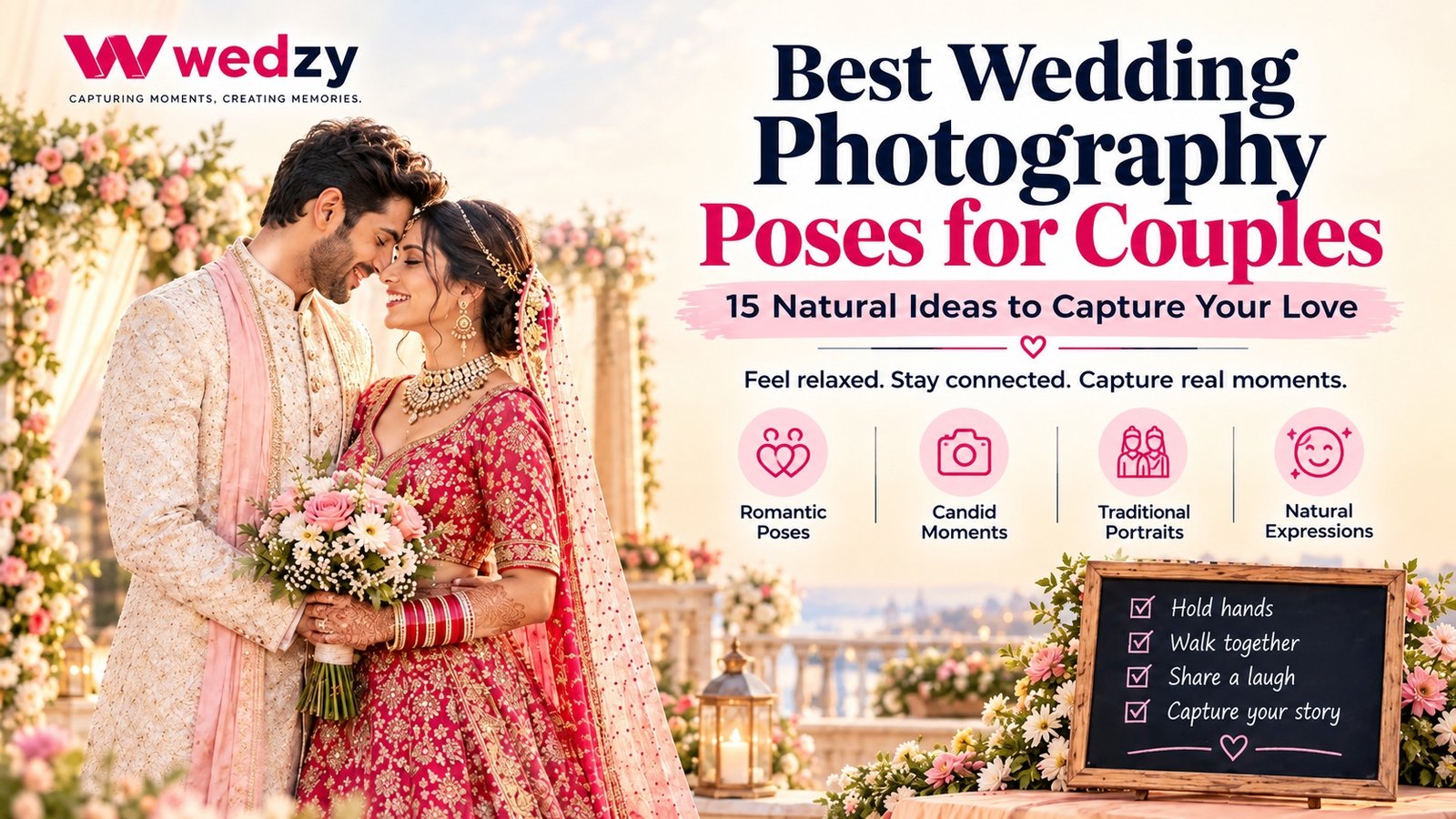
Not everyone feels comfortable standing in front of a camera. Some couples know exactly how they want their wedding photos to look, while others start feeling awkward the moment the photographer asks them to pose. Should you hold hands, look at each other, smile at the camera, or simply stand together?
The good news is that beautiful wedding photographs do not require professional modelling skills. Often, the most memorable pictures come from small gestures, shared laughter, a quiet moment, or the way you naturally look at each other.
Choosing the right wedding photography poses can help you feel more relaxed and make your wedding album look personal rather than overly staged. From romantic portraits and traditional poses to playful candid shots, there are plenty of ways to capture your relationship.
In this guide, we will explore wedding poses for couples that work across different wedding styles, along with practical tips to help you feel confident in front of the camera.

Plan Your Wedding With Verified Professionals
Verified
Professionals
Trusted
Company
Easy EMI &
Secure Booking
Let's get started with a few details ✨
We never share your details.
1. Classic Wedding Photography Poses That Never Go Out of Style
Classic poses remain popular because they are simple, elegant, and easy to personalise. They also work well for wedding albums, framed photographs, and family portraits.
The Hand-in-Hand Pose
One of the easiest poses is to stand beside each other while holding hands. You can look towards the camera, exchange a smile, or walk slowly together.
This pose works particularly well when you want a relaxed photograph without complicated instructions. It also looks lovely when the photographer captures the full wedding outfits.
Tip: Keep your shoulders relaxed and avoid gripping your partner’s hand too tightly. A natural posture makes a noticeable difference.
The Forehead Touch
For a more intimate portrait, stand close together and gently touch your foreheads. You can close your eyes or smile softly at each other.
This pose is ideal for couples who prefer emotional photographs over big, dramatic expressions. It also creates a lovely close-up that highlights your faces, jewellery, makeup, and wedding attire.
The Classic Side-by-Side Portrait
Sometimes, a straightforward portrait is all you need. Stand close together, angle your bodies slightly towards each other, and look at the camera.
This is a useful photograph for wedding announcements, framed prints, and family albums. Ask your photographer to capture both a full-length version and a closer portrait so that you have different options.
2. Romantic Wedding Poses for Couples
Romantic poses are about creating a sense of connection rather than trying to look perfect. Small movements and genuine expressions often produce more natural results than holding a pose for too long.
The Gentle Hug
Ask one partner to stand slightly behind the other and wrap their arms gently around their waist or shoulders. You can both look at the camera, or the partner behind can look towards the other’s face.
This pose works well for traditional outfits, modern wedding clothes, and outdoor portraits. It is also a comfortable option if you are unsure what to do with your hands.
The Almost-Kiss Pose
Instead of an actual kiss, move close together and pause just before your lips touch. Look at each other rather than at the camera.
The photographer can capture the anticipation and emotion of the moment without making the pose feel too formal. If you prefer candid photographs, ask your photographer to take a few frames while you naturally move closer.
The Walking-Together Pose
Walk slowly side by side while holding hands. Talk to each other, smile, or share a private joke.
Walking photographs are especially useful when you feel stiff during stationary portraits. Since you are moving, your expressions and body language may become more relaxed.
A practical tip: Walk at a comfortable pace and repeat the movement a few times. Your photographer can capture different expressions and angles without asking you to hold an uncomfortable position.
3. Candid Wedding Photography Poses for Natural Moments
Not every wedding photograph needs a carefully planned pose. Candid photography focuses on genuine reactions and interactions, allowing your personality to become part of the story.
Laughing Together
Ask your partner a funny question, talk about something that happened during the wedding, or simply remember a shared joke.
Real laughter often creates more personality than a forced smile. Your photographer can capture the moment while you interact naturally.
These photographs work particularly well during couple portraits, pre-wedding sessions, and relaxed moments between ceremonies.
A Quiet Moment Away From the Crowd
Wedding days can be busy. Between ceremonies, guests, family photographs, and celebrations, couples do not always get time to pause together.
A photograph of you sitting side by side, holding hands, or talking quietly can preserve a different side of the day.
For example, your photographer might capture you sitting near a window before the ceremony or sharing a peaceful moment after the wedding rituals.
The Looking-Back Shot
Walk away from the camera together, then turn your heads slightly towards each other or look back at the photographer.
This pose creates a different perspective and allows the photographer to include more of the surroundings. It can also show the back of your wedding outfits, including dupattas, veils, embroidery, or other design details.
For the most natural result, avoid turning your entire body at once. A gentle movement is usually enough.
4. Creative Wedding Poses That Highlight Your Outfits and Setting
Your wedding photographs should capture more than expressions. They should also preserve the details of your clothing, the atmosphere of the venue, and the setting you chose for the celebration.
The Bridal Outfit Detail Pose
If the bride is wearing a detailed lehenga, saree, or gown, ask the photographer to capture a portrait that shows the outfit clearly. The groom can stand beside her, hold her hand, or look towards her.
This gives the photographer an opportunity to capture embroidery, jewellery, fabric movement, and the overall look without making the image feel like a fashion catalogue.
The Veil or Dupatta Frame
A veil or dupatta can create a soft frame around the couple. Stand close together while the photographer uses the fabric to add depth and texture to the photograph.
Make sure the fabric is arranged comfortably and does not cover your face in a way you dislike. The photographer should also check that the lighting is suitable for both faces.
The Silhouette Pose
Silhouette photographs use backlighting to create a darker outline of the couple against a brighter background.
A sunset, a large window, or an illuminated venue entrance can provide suitable conditions. Stand close together, hold hands, or lean towards each other to create a recognisable shape.
Because the faces may appear dark, ask for a few normally exposed portraits as well. This ensures that you have both artistic photographs and clear pictures of your expressions.
The Staircase or Venue Portrait
If your venue has an attractive staircase, balcony, decorated entrance, or architectural feature, use it as part of the composition.
The couple can stand at different levels, walk towards each other, or pause together on the stairs. Your photographer should choose a position that keeps the pose comfortable and avoids awkward body angles.
Always follow venue rules and avoid standing on unsafe edges or climbing onto decorative structures.
5. Traditional Indian Wedding Poses for Couples
Indian weddings often include several ceremonies, outfit changes, and meaningful family traditions. Your wedding photographs can reflect these details while still feeling personal.
The Garland Exchange Pose
During the varmala or jaimala ceremony, the couple exchanges flower garlands. Ask your photographer to capture the exchange, the expressions immediately afterwards, and the reactions of family members.
Rather than focusing only on a perfectly arranged pose, these moments can preserve the excitement and humour of the ceremony.
The Blessings and Togetherness Pose
After a ceremony, the couple may stand together while receiving blessings from parents or elders. These photographs can become meaningful parts of the family album.
Your photographer can capture both the interaction with family members and a separate portrait of the couple afterwards.
The Wedding Ritual Close-Up
Include photographs of your joined hands, exchanged rings, wedding jewellery, or other meaningful ritual details relevant to your ceremony.
These close-ups add variety to your album and help tell the story of the wedding beyond the main portraits.
Not every couple follows the same traditions, so discuss the ceremonies that matter most to you before the wedding day.
6. How to Pose Naturally and Feel Confident in Front of the Camera
Even a beautiful location and well-planned pose cannot guarantee a photograph you love if you feel uncomfortable. A few simple preparations can help.
Talk to Your Photographer Before the Wedding
Share a few reference images that reflect your preferred style. Explain whether you like romantic portraits, candid moments, traditional photographs, or a mixture.
You do not need to recreate every reference image exactly. Use them to communicate the mood and composition you prefer.
Suggested internal link: Add a link here to a related guide on How to Choose the Right Wedding Photographer in Mumbai.
Practise a Few Comfortable Poses
You do not need to rehearse fifteen different poses. Practise holding hands, standing close together, walking side by side, and looking at each other.
These simple movements give your photographer a starting point. On the wedding day, they can adapt them to your outfits, location, and lighting.
Pay Attention to Your Hands and Posture
One common reason couples feel awkward is that they do not know where to place their hands. Hold your partner’s hand, rest a hand gently on their arm, or place your hand naturally around their waist.
Keep your shoulders relaxed and avoid forcing a particular smile. If a pose feels uncomfortable, tell your photographer so they can suggest an alternative.
Allow Enough Time for Couple Portraits
Wedding schedules can become hectic, particularly when several ceremonies happen on the same day. If possible, set aside a dedicated period for couple portraits.
Even a short, planned session can provide enough time for a variety of photographs without making you feel rushed. Discuss the schedule with your photographer beforehand, including the best available light and any venue restrictions.
Suggested internal link: Link this section to a guide on Wedding Photography Timeline or Wedding Photography Checklist.
Frequently Asked Questions
1. What are the best wedding photography poses for couples?
The best poses include holding hands, walking together, forehead touches, gentle hugs, almost-kiss portraits, and candid laughter. Choose poses that feel comfortable and reflect your relationship rather than following every trend.
2. How can couples pose naturally for wedding photos?
Focus on interacting with your partner instead of constantly looking at the camera. Walk together, share a conversation, hold hands, or exchange a smile. Relax your shoulders and let the photographer guide you through small adjustments.
3. Which wedding poses work best for Indian couples?
Popular options include varmala photographs, traditional couple portraits, outfit-detail shots, forehead touches, and photographs taken during meaningful wedding rituals. The best choices depend on your traditions, outfits, venue, and personal preferences.
4. Should we practise wedding poses before the wedding day?
Practising a few simple poses can help you feel more confident, but extensive rehearsal is unnecessary. A pre-wedding photoshoot can also help you understand your preferred angles and become comfortable working with your photographer.
5. How many couple poses should we include in our wedding album?
There is no fixed number. Aim for variety rather than quantity, including traditional portraits, romantic close-ups, full-length outfit photographs, candid interactions, and pictures with your wedding venue. Your photographer can help balance these with ceremony and family photographs.
Plan Your Wedding With Verified Professionals
Verified
Professionals
Trusted
Company
Easy EMI &
Secure Booking
Let's get started with a few details ✨
We never share your details.
Conclusion
The best wedding photography poses are not necessarily the most complicated ones. A simple hand-in-hand portrait, a spontaneous laugh, or a quiet moment together can become one of your favourite wedding memories.
Plan a few poses that suit your personality, communicate your preferences to your photographer, and leave room for unplanned moments. A balanced wedding album should include a mix of classic portraits, romantic photographs, candid expressions, and meaningful details.
If you are preparing for your wedding, start by collecting a few reference photographs and discussing your ideas with your photographer. With a little planning and a relaxed approach, you can create wedding photographs that feel authentic to you as a couple.